
Decorative Flooring That Holds Up Under Daily Use
Flaked Floors in Morristown for garages, basements, and commercial spaces with heavy foot and vehicle traffic
Flake epoxy floors are built in layers, and the sequence of those layers is what determines whether the decorative finish holds up for years or begins lifting within a season. Volunteer Epoxy Flooring installs flake epoxy floors in Morristown across garages, basements, shops, and commercial spaces, beginning each installation with a diamond-ground slab, crack filling, and a moisture check before any decorative material goes down. Skipping or compressing any of those steps produces a floor where the flake finish separates from a base that was never properly bonded to the concrete beneath it.
The preparation sequence uses 16-grit diamond tooling to open the concrete surface and create a mechanical profile. Cracks are filled and moisture is evaluated before the epoxy base coat is applied, because moisture vapor pushing through the slab will lift a coating regardless of how well it was applied. Lake properties and homes with below-grade basements near Morristown often present elevated slab moisture, and identifying that condition before installation determines whether a vapor barrier is part of the system or whether the standard base coat is sufficient.
Request a free on-site estimate from Volunteer Epoxy Flooring to have your slab evaluated for moisture and crack conditions before a flake system is specified.
Once the slab is prepared and the base coat is down, the decorative flake is broadcast into the wet epoxy. The density of the broadcast determines coverage, and the flake is allowed to cure into the base before the clear topcoat is applied. That topcoat seals the flake in place, creates the slip-resistant texture of the finished floor, and provides the chemical resistance that makes flake floors practical under vehicle traffic, foot traffic, and fluid exposure. The topcoat is a separate pour, not a thin wipe, which matters for how long the surface holds its texture.
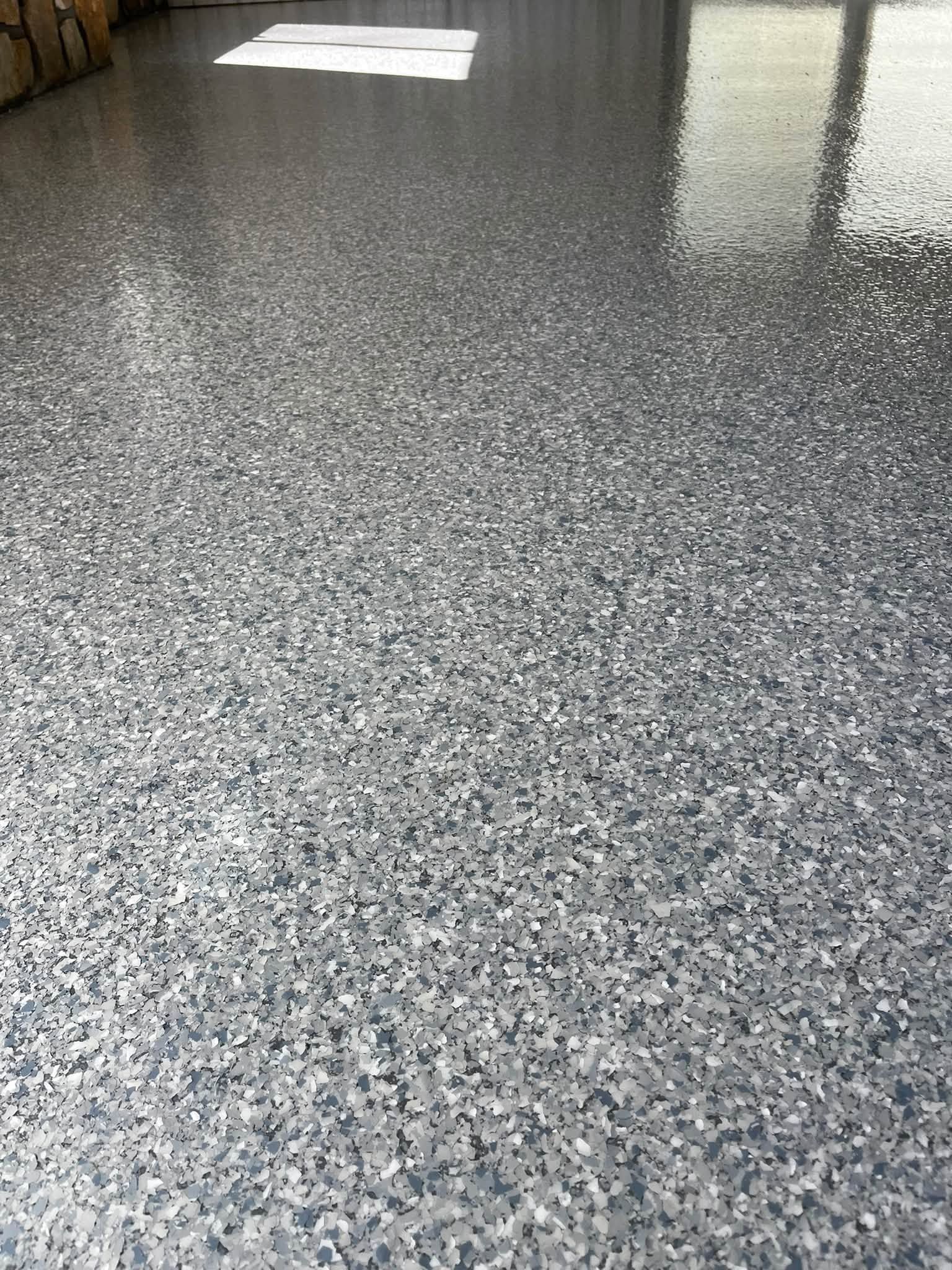
A finished flake floor reads as a continuous, textured surface with no visible seams between the base coat and the flake layer. Tire marks wipe off rather than embedding into the surface, spilled fluids sit on top rather than wicking into the concrete, and the floor does not require stripping or waxing to maintain its appearance. The slip-resistant texture built into the topcoat remains functional without adding treatment products over time.
Volunteer Epoxy Flooring backs flake installations with a warranty on the work, and the business is licensed and insured. The flake color blends available allow the decorative choice to suit the space, whether the floor is a residential garage in Dandridge or a commercial shop floor in Morristown, without the installation process varying by location.
Common Questions About This Service
The questions below address how flake epoxy floors are installed, what decisions are made during the process, and what distinguishes a properly built flake system from a compressed installation.
What is the purpose of the clear topcoat in a flake epoxy system?
The topcoat seals the broadcast flake into the base coat so it cannot be dislodged by traffic, and it also provides the chemical resistance and slip texture of the finished floor. Without a proper topcoat, the flake layer is exposed to abrasion and will wear through at traffic points.
Why does moisture in the slab matter specifically for flake floors?
Moisture vapor migrating through concrete creates pressure against any coating applied over it. If the base coat is applied without addressing elevated moisture, the vapor pressure builds beneath it and causes the entire system, including the flake layer above, to lift away from the concrete. The moisture check before installation determines whether a vapor barrier is added as the first layer.
How does the diamond grinding step affect how the flake system bonds?
Sixteen-grit diamond grinding cuts an open profile into the concrete surface, creating physical anchor points for the epoxy base coat. The base coat fills those points and locks in mechanically, which means the bond is not relying on surface adhesion alone. Flake broadcast into that base coat then becomes part of a system that is anchored to the slab rather than sitting on top of it.
How are crack repairs integrated into a flake installation rather than treated as a separate job?
Crack filling happens as part of the preparation sequence, after grinding and before the base coat. Cracks filled and ground flush at that stage are covered by the epoxy base coat as part of the normal pour, so the filled section does not create a visible interruption in the flake finish above it.
What should a properly finished flake floor look like when installation is complete?
The flake coverage should be consistent across the slab without bare patches or uneven density, the topcoat should sit level without pooling at low spots, and the surface texture should be uniform. Running a hand across the finished floor should produce the same texture in every direction without catching on exposed flake edges.
Volunteer Epoxy Flooring also installs flake epoxy floors in Jefferson City, Newport, Rogersville, Greeneville, and Dandridge. To walk through your space and get a written scope at no cost, call (423) 273-9952 and schedule your free estimate.