
Floor Coatings That Hold Against Moisture
Polyaspartic floor finishes in Morristown for garage slabs and shop floors where moisture rising through the pad has failed previous coatings
A coating applied over a slab that is actively transmitting moisture vapor will fail—the vapor pressurizes under the film and the coating lifts, bubbles, or peels within months regardless of product quality. Volunteer Epoxy Flooring installs polyaspartic floor finishes in Morristown with a preparation sequence that addresses this directly: every slab is moisture-tested before anything is applied, and where moisture is a concern, a vapor barrier goes down first. The service covers garages, shops, and commercial floors where prior coating failures have already made the moisture issue visible.
The crew grinds the slab to bare concrete, repairs cracks exposed during grinding, and tests for moisture vapor transmission before selecting a system. Because polyaspartic base coats have low moisture vapor resistance by design, Volunteer Epoxy Flooring does not offer a one-day coating on slabs with confirmed moisture risk—the vapor barrier step is added when the testing warrants it, and the coating sequence follows once that layer is in place. The result is a UV-stable topcoat bonded to a properly prepared surface rather than a finish that looks right initially and fails before the first year is out.
Arrange a free estimate to have your slab moisture-tested and reviewed before committing to a coating system.
Older block and slab garages in the Morristown and Jefferson City area were frequently built without a vapor barrier under the pad, or with barriers that have degraded over decades. Those slabs transmit moisture at rates that vary by season and by how much water is present in the ground beneath them—which is why a visual inspection alone cannot confirm whether a direct coating is safe. The moisture test produces a measurable number that drives the system selection, not a judgment call made at the time of application.
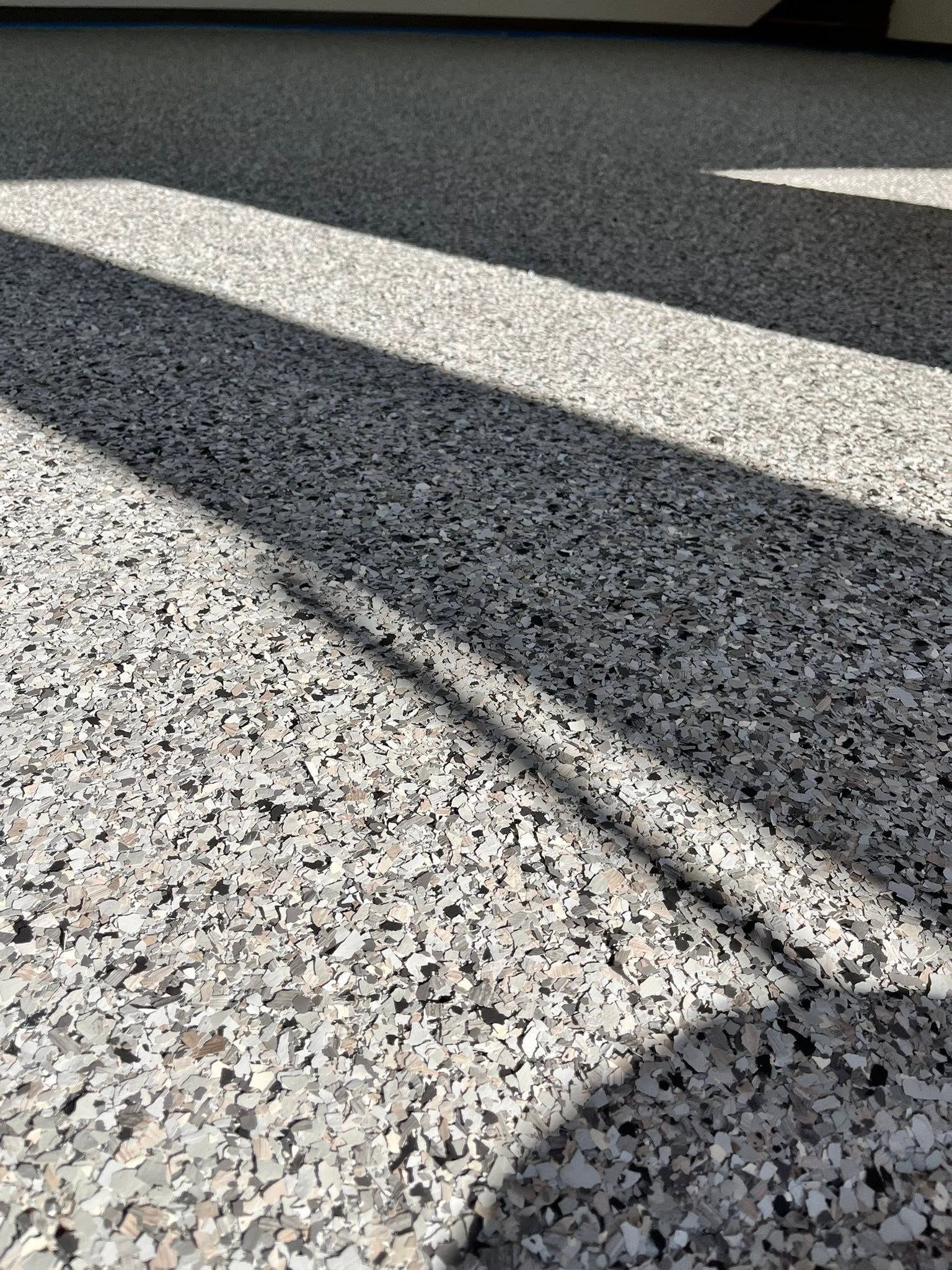
Once the polyaspartic system cures on a properly prepared slab, the surface is noticeably harder underfoot than an unprepared floor and resists the yellowing that epoxy-only finishes develop under UV exposure through garage doors and skylights. Stains from fluids bead on the surface rather than penetrating, and the finish does not soften or dull under repeated cleaning. The UV stability difference between polyaspartic and standard epoxy becomes apparent over the first couple of years, particularly in spaces with significant light exposure.
The polyaspartic topcoat is the UV-stable layer, but the durability of the whole system depends on the base coat bonding to sound concrete—which is why the grinding and crack repair steps are not abbreviated regardless of how a slab looks before work begins. Visible cracks exposed during grinding are filled and allowed to cure before the base coat goes down.
What to Know Before Coating Your Garage Floor
The following answers address how polyaspartic installation works, what the moisture testing step involves, and what the finished surface looks like once the system is complete.
What does moisture testing actually involve on a concrete slab?
The crew uses a calcium chloride or relative humidity probe test to measure how much moisture vapor the slab is transmitting—the result determines whether a direct base coat is safe or whether a vapor barrier layer is required first.
Why does a polyaspartic base coat have low moisture vapor resistance?
Polyaspartic chemistry cures fast and bonds hard, but the film is not designed to hold back vapor pressure from below—that job belongs to a dedicated moisture vapor barrier applied under the base coat when testing confirms the need.
How does crack repair fit into the coating sequence?
Cracks are filled after grinding and before any coating is applied, because a coating bridged over an open crack will flex and eventually fail along that line; the filler needs to cure fully before the base coat goes down.
What makes polyaspartic finishes hold their color better than standard epoxy?
Polyaspartic resins are aliphatic rather than aromatic, meaning the molecular structure does not break down the same way under UV exposure—the topcoat retains its clarity and color rather than yellowing or chalking in spaces with direct light.
How should a polyaspartic floor be maintained once it cures?
Routine cleaning with a pH-neutral cleaner and a soft mop preserves the topcoat finish; abrasive scrubbers or harsh solvents can dull or scratch the surface, so the cleaning method matters for keeping the finish intact over time.
Volunteer Epoxy Flooring also installs polyaspartic finishes in Jefferson City, Newport, Rogersville, Greeneville, and Dandridge. To discuss your slab's specific condition and get a free estimate, call Volunteer Epoxy Flooring at (423) 273-9952.